
Operation Anthropoid, a Child’s Coffin and Prague’s Hidden Mass Graves
There are places in Prague which almost everybody knows, and then there are places which somehow remain almost invisible even to people who have lived here for years. The northern part of Ďáblice Cemetery is one of them.
I started researching this part of the cemetery properly in 2022, while developing the longer versions of my Operation Anthropoid tours. I knew Ďáblice before, but I honestly had no idea how much history was hidden at its northern end. The more I researched it, the more complicated it became.
Today, Ďáblice Cemetery is a stop on both my 4-hour Operation Anthropoid in Prague tour and my Operation Anthropoid in Detail tour with Lidice.
At first, I became interested in the cemetery because of its mass graves and the long-repeated theory that some of the Operation Anthropoid parachutists and their helpers could be buried here. New research has since changed quite a lot of that story.
But there is one connection between Ďáblice Cemetery and Operation Anthropoid which is not based on a theory at all.
During the Nazi occupation, the resistance hid parachutist equipment inside a small child’s coffin and arranged a fake funeral at Ďáblice Cemetery.
I honestly think this is one of the best and least-known Anthropoid stories in Prague.
Operation Anthropoid Equipment Hidden in a Child’s Coffin
When Jozef Gabčík and Jan Kubiš were parachuted into occupied Czechoslovakia, hiding the two men was only part of the problem. Their support network also had to deal with the material they had brought with them: parachutes, harnesses, flying overalls, field equipment and anything else which could immediately connect a Czech family with British-trained Czechoslovak parachutists.
Being caught with something like this during the Protectorate was obviously extremely dangerous. After the attack on Reinhard Heydrich, with the Gestapo searching Prague and arresting people connected with the resistance, the equipment had to disappear.
The Smrž and Khodl families were among the people involved in helping Gabčík and Kubiš. Some of the material was extremely difficult to destroy. Jaroslav Smrž had even sewn one of the parachutes into an ottoman after attempts to burn it had failed.
Eventually, they found a much better solution.
With the involvement of Václav Smrž and funeral director Vojtěch Paur, parachutist equipment was placed inside a small child’s coffin. A false burial was arranged and the coffin was transported to Ďáblice Cemetery as though a child was genuinely being buried. Emanuela Khodlová attended as the supposed relative and mourner.
Except there was no child inside the coffin.
There were parachute harnesses, flying overalls, field shovels and other material connected with Operation Anthropoid. The coffin was buried in the children’s section in grave No. 135/8/IV. The Germans never discovered what was actually inside and, after liberation in May 1945, the equipment was dug up and handed over to the Czechoslovak Ministry of National Defence.
The story is documented in material preserved by the Military History Institute Prague.
When you think about the practical side of this, it is quite unbelievable. Somebody had to arrange the coffin and paperwork, somebody had to transport it through occupied Prague, and somebody had to stand beside the grave pretending that a child was being buried.

We naturally concentrate on Gabčík and Kubiš when talking about Operation Anthropoid, but the operation depended on a huge number of ordinary people taking risks like this.
And they managed to fool the Gestapo.
There is also one important distinction to make here: this fake child’s grave and the later collective mass-grave shafts at Ďáblice are not the same thing.
The Anthropoid equipment was hidden in an individual fake grave. The documented system of collective shaft graves at the northern end of the cemetery did not begin until 7 August 1943.
That date becomes very important.
A Cubist Cemetery in Northern Prague
Ďáblice Cemetery was established in 1912. For centuries, people had normally been buried around churches, often directly in towns and villages. This gradually changed under Emperor Joseph II, when cemeteries were moved away from populated areas, largely for hygienic reasons.
What makes Ďáblice unusual even before we reach its darker history is its architecture. The entrance structures, walls and original concept were designed by Vlastislav Hofman in Czech Cubist style.
Prague is one of the few places where Cubism became architecture as well as art, and a Cubist cemetery is unusual even for Prague.
But when I bring people here, the architecture is only the beginning. We continue towards the northern side, where the cemetery changes completely.

The Ďáblice Cemetery Mass Graves
The northern area contains collective graves known in Czech as šachtové hroby, or shaft graves.
They were not originally created specifically for political prisoners or members of the resistance. The system was used for social burials, unidentified people, remains from hospitals and medical institutions, prisoners and others who did not receive a normal individual grave.
The burials were also organised very differently from what most people imagine when they think of a cemetery. Coffins and boxes could be placed in layers, and remains belonging to more than one person could sometimes be placed together.
For decades there were different theories about when the Ďáblice shaft system began. Recent archival research by the Institute for the Study of Totalitarian Regimes, ÚSTR, established the documented starting date as 7 August 1943, after the earlier collective burial system at Vinohrady Cemetery had run out of space. Read the ÚSTR research on the Ďáblice shafts
And this is where the old Operation Anthropoid story becomes much more complicated.
Are Gabčík and Kubiš Buried at Ďáblice Cemetery?
When I first started researching Ďáblice seriously in 2022, I also believed the widely repeated theory that Jozef Gabčík, Jan Kubiš and some of the people connected with Operation Anthropoid could eventually have been buried here.
I was hardly alone in believing it. This had appeared in books, articles and memorial material for years.
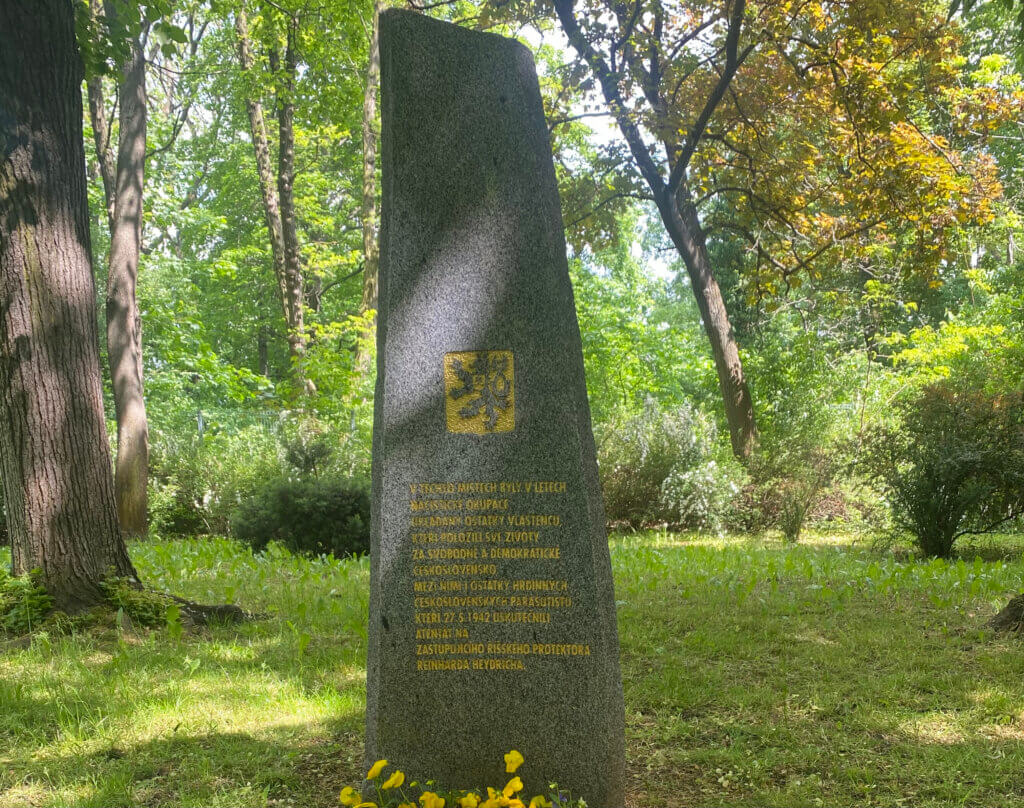
Among the names associated with Ďáblice were Gabčík and Kubiš themselves, Marie Moravcová, known as “Auntie Moravec” in the film Anthropoid, Jan Zelenka-Hajský, Alfréd Bartoš, Jiří Potůček and others. There is also a memorial here connected with the parachutists and the resistance.
But then we come back to 7 August 1943.
Gabčík, Kubiš and the other five men who fought their last battle in the Church of Saints Cyril and Methodius died on 18 June 1942. Auntie Moravec died in June 1942. Jan Zelenka-Hajský and Alfréd Bartoš also died that month, while Jiří Potůček died in July.
If the collective shafts at Ďáblice were not operating until August 1943, the older interpretation becomes very difficult to maintain.
Newer research has therefore brought Vinohrady Cemetery back into the discussion because its collective graves were operating earlier and received remains from some of the same Prague institutions. That does not mean we can simply point to Vinohrady and say everybody from 1942 is there. The fate of some remains involved anatomical institutes, cremation facilities and several stages of handling. There are still unanswered questions.
Today I would never stand at Ďáblice and tell my clients that Gabčík and Kubiš are definitely buried underneath us.
We simply do not know that.
I also do not find it embarrassing that I once accepted the older interpretation. It was widely repeated for a long time. Good historical research means changing what we say when better evidence appears.
For me, that is part of guiding history properly. Sometimes the honest answer has to be we don’t know.
The memorial at Ďáblice remains important. A symbolic memorial and a physical grave are not necessarily the same thing.
And meanwhile we have the completely documented Anthropoid connection which I actually find even better: the parachutists’ equipment really was hidden here inside a child’s coffin.
Nazi Victims, Čurda, Gerik and Karl Hermann Frank
The new dating of the shafts does not mean Ďáblice loses its connection with victims of Nazi persecution. From 1943 onwards, remains were brought here from hospitals, prisons, anatomical institutes and other Prague institutions. Researchers are still trying to establish the identities of some of the people buried within the system.
After the war, another group became connected with the cemetery: people executed in the Czechoslovak post-war retribution trials.
These were not the Nuremberg Trials. Czechoslovakia conducted its own proceedings against Nazi officials, war criminals, collaborators and informers.
One particularly uncomfortable name in the Anthropoid story is Karel Čurda. He had been trained in Britain and parachuted into the Protectorate as a Czechoslovak soldier, but after Heydrich’s assassination he went to the Gestapo and provided detailed information about people connected with the resistance. His betrayal helped the Germans identify families who had hidden and assisted the parachutists. Arrests and interrogations followed, and many of those people were eventually murdered.
After the war, Čurda was tried for treason and executed in 1947. Viliam Gerik, another former parachutist who collaborated with the Gestapo, was executed with him. Both have been connected with burial at Ďáblice, although the exact position of individual remains is another question.
Karl Hermann Frank, one of the most powerful Nazi officials in the Protectorate, was also buried at Ďáblice after his execution in May 1946. Newer research places Frank in a different section of the cemetery, separate from the northern honorary burial ground.
That distinction matters because the story is sometimes simplified into heroes and Nazis being thrown into exactly the same shaft. The reality is more complicated.

The Children’s Cemetery
There is another part of the northern area which I always stop at: the Dětský hřbitov, or Children’s Cemetery.
At first glance, the small stones make it look like a normal children’s burial ground. In reality, what lies underneath does not necessarily correspond neatly with the markers above.
Children, including newborn babies from hospitals and institutions, were also placed within the collective burial system. Records are incomplete, and several sets of remains could sometimes be placed within a single coffin or box.
This became particularly clear during archaeological work in 2020, when researchers were searching for Zdena Mašínová Sr. A relatively small investigation uncovered twelve coffins containing the remains of around thirty people, both adults and children.
So one small stone above ground does not necessarily mean one child lies directly underneath it.
And again, the child’s coffin containing the Anthropoid equipment was a separate fake grave, not part of these later collective shafts.
Milada Horáková and the Third Resistance
After the Communist takeover in 1948, Ďáblice gained another group of political victims. People were executed or died in prison, and in many cases their families were not given the bodies.
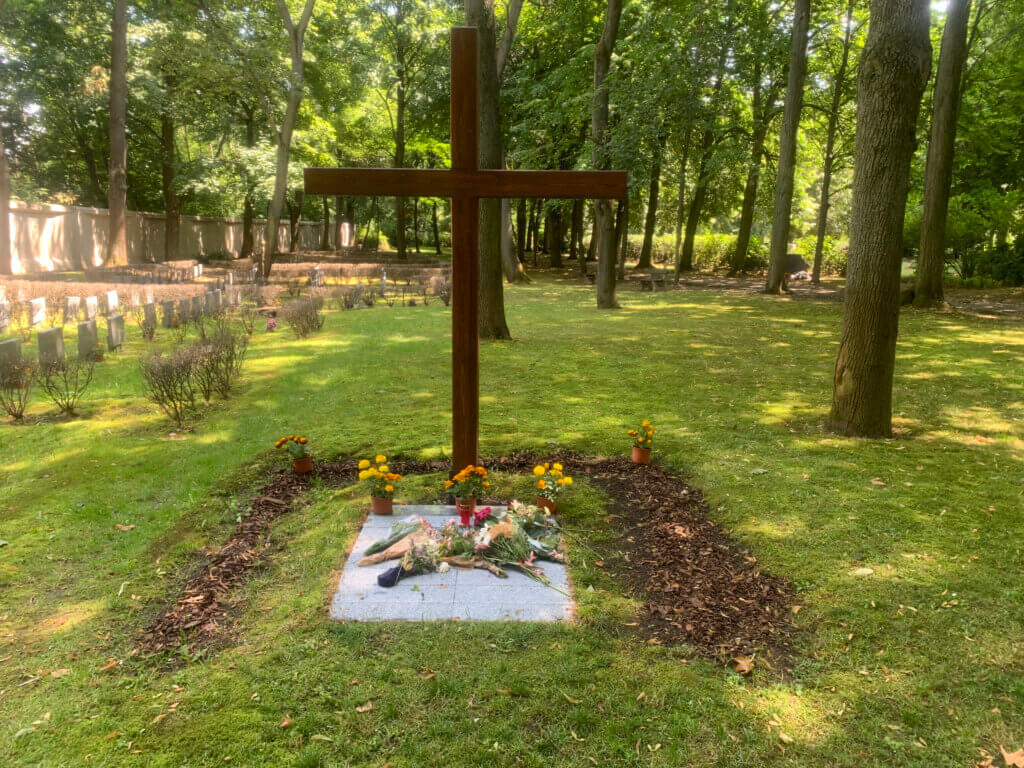
After 1989, the northern part of Ďáblice became an important memorial site connected with the Third Resistance, or Třetí odboj, the resistance against Communist dictatorship.
One of the most famous symbolic graves here belongs to Milada Horáková.
I always speak about Milada when I bring people here because her story connects both dictatorships. She had already been active in resistance against the Nazis and was arrested by the Gestapo in 1940. She spent part of her imprisonment in the Small Fortress of Terezín before being transferred elsewhere within the German prison system.
She survived the Nazis.
After the Communist takeover, she was arrested again in 1949 and became the central defendant in one of the most notorious political show trials in Czechoslovak history. The trial was prepared in advance to an extraordinary degree, including expected statements and answers, while the defendants were subjected to months of interrogation and pressure.
Milada Horáková was sentenced to death.
Her final meeting with her teenage daughter Jana is one of the details I always remember. They were allowed to see each other shortly before the execution, but they were not allowed to hug.
Milada was executed at Pankrác Prison on 27 June 1950. Before her death she wrote farewell letters to her family, but the Communist authorities did not deliver them. Jana received those letters only after the fall of Communism, almost forty years later.
Milada Horáková’s remains have never been conclusively located, so the grave carrying her name at Ďáblice is symbolic.
For anyone who knows very little about her story, the 2017 film Milada, starring Ayelet Zurer, is useful further viewing. It is a drama rather than a documentary, but it gives a good introduction to her story and the political trial.
Josef Toufar and Zdena Mašínová
Two stories probably explain the difficulty of identifying the dead at Ďáblice better than anything else.
Catholic priest Josef Toufar was arrested after the so-called Číhošť miracle, when witnesses reported that a cross inside his church moved during Mass in December 1949. The Communist authorities tried to force him to confess that he had faked the event. He was brutally tortured and died on 25 February 1950.
His body was secretly taken to Ďáblice and registered under the false name Josef Zoukal.
For decades his family did not know where he was. Historian Miloš Doležal later pieced together cemetery records, witness testimony and State Security documentation. In 2014, archaeologists found Toufar’s remains and genetic testing helped confirm his identity. In 2015 he was finally reburied in Číhošť. Read more about the identification of Josef Toufar at ÚSTR
The search for Zdena Mašínová Sr. had a very different result.
She was the wife of Josef Mašín, one of the legendary Three Kings of the anti-Nazi resistance. Her family suffered persecution under the Nazis and later again under the Communist regime. She was sentenced to 25 years in prison and died in 1956. Her body was not returned to the family, and there are strong reasons to believe she was secretly buried at Ďáblice.
Her daughter, Zdena Mašínová Jr., has spent years trying to locate her. Archaeological work was carried out in 2020 and human remains were found, but her mother was not identified.
So at Ďáblice we have Josef Toufar, who was found after more than sixty years, and Zdena Mašínová, who has still not been found.
That tells you quite a lot about how difficult these exhumations really are.
The Petition, DNA and a Historical Pandora’s Box
Around 2022, plans for a new memorial treatment of the northern burial ground created another debate.
Historian Jaroslav Čvančara, actor Ondřej Vetchý, Pavel Černý and others argued that the graves should first be properly investigated and, where possible, resistance fighters and political prisoners should be identified and given individual burials.
The initiative became known as “Petice za důstojné vyzvednutí a pohřbení ostatků našich hrdinů.”
DNA research also became part of the project. One of the relatives who agreed to provide a sample was Katarína Tomčíková, the great-niece of Jozef Gabčík, whom I have personally met twice.
I completely understand why families and historians want to identify these people. The case of Josef Toufar proves how meaningful it can be.
At the same time, I have always seen the idea of opening all these graves as something of a historical Pandora’s box. There are thousands of remains, some incomplete or mixed, some belonging to children, and the surviving documentation is not always reliable.
How many other dead people do you disturb while trying to identify one person?
I do not think there is a simple answer.
What Is Happening at Ďáblice Now?
The petition did achieve something important.
In 2023, the Czech government created an expert commission to investigate the Ďáblice graves properly. Researchers began working systematically through cemetery books, archival records and prison documentation. Read about the creation of the government Ďáblice commission
Ironically, research encouraged partly by the hope of finding Gabčík, Kubiš and other Anthropoid figures also helped establish the 7 August 1943 starting date of the shafts, making their burial in those particular graves much less likely.
To me, that is not a failure. That is simply what historical research is supposed to do.
In 2025, a pilot exhumation project focused on three men executed by the Communist regime in 1949: Karel Sabela, Miloslav Jebavý and Vilém Sok-Sieger. The work again showed how difficult it can be to translate old burial records into an exact position underground many decades later.
Further coordination has since moved to ÚSTR, with historians, archaeologists and forensic specialists continuing to investigate individual cases. The planned memorial treatment of the site has not disappeared either, but future archaeological investigation is supposed to remain possible rather than permanently sealing access to the graves.
So the story of Ďáblice is still developing.
Why I Bring People to Ďáblice Cemetery
When I first started researching this part of Ďáblice in 2022, I was mainly interested because I believed, like many others, that some of the Operation Anthropoid parachutists themselves might be buried here.
Today I would not tell my clients that as a fact.
What I actually find more interesting now is that the real Anthropoid connection is not theoretical at all. During the Nazi occupation, the Czech resistance really brought parachutist equipment to this cemetery, put it inside a small child’s coffin, arranged a fake funeral and successfully hid it from the Gestapo until liberation.
And once we continue through the cemetery, the story becomes much bigger than the assassination itself. It takes us from the resistance families who helped the parachutists to betrayal, Nazi reprisals, post-war justice, Communist repression, political prisoners and the question of what we should do with these graves today.
That is why I include Ďáblice Cemetery on both my 4-hour Operation Anthropoid in Prague tour and my Operation Anthropoid in Detail tour with Lidice.
It is not there because I need another stop on the itinerary. I bring people here because Operation Anthropoid was never only the assassination of Reinhard Heydrich and the last battle in the church crypt. It involved helpers, resistance families, betrayals, reprisals, anonymous burials and consequences which continued long afterwards.
I have already changed parts of the story I tell at Ďáblice because the research has changed since I first started bringing people here.
I expect we will learn more in the future.
And when we do, I will change the story again.