
A place of remembrance beyond Prague’s familiar sights
Between the apartment buildings of Prague 8 lies Kobylisy Shooting Range—Kobyliská střelnice, a former military training ground that the Nazis turned into an execution site.
You could walk through the surrounding neighbourhood without realising what happened behind these grassy banks. Yet among those murdered here were a prime minister, a senator, writers, soldiers, church representatives and boys aged just fifteen.
For me, Kobylisy belongs in the story of Operation Anthropoid alongside Heydrich’s Curve and the church on Resslova Street. It helps explain the wider persecution, the resistance and the consequences of helping others under occupation.
That is why we include this memorial in both our four-hour and eight-hour private Operation Anthropoid tours.
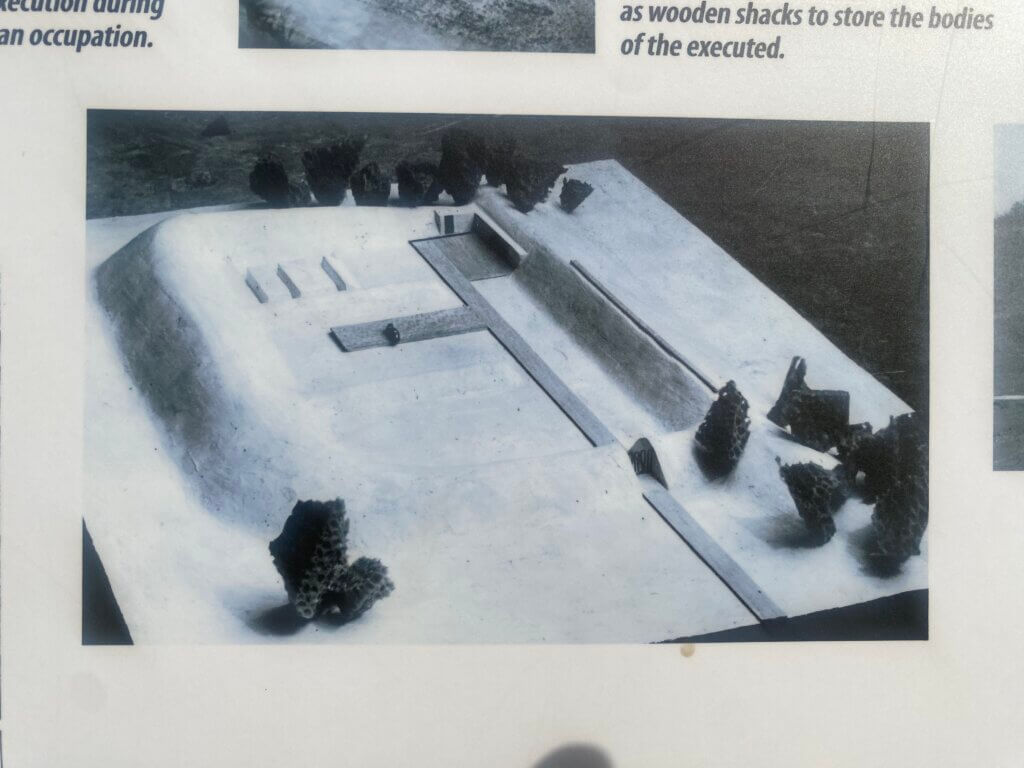
Before WWII: a military shooting range under Austria-Hungary
Built between 1889 and 1891, Kobylisy Shooting Range originally served infantry rifle training for the Austro-Hungarian army. The complex was considerably larger than the memorial we see today, with five shooting sectors, target lines and protective earth banks.
Those banks were practical military structures, built to contain gunfire and protect the surrounding area. They help explain the unusual landscape that survives between today’s residential buildings.
Before the First World War, the grounds also hosted military-band concerts, riding activities and gatherings with refreshments. Its documented original purpose was military training; reliable evidence of executions here during the monarchy has not been established.
Kobylisy during the First Czechoslovak Republic
After Czechoslovakia became independent in 1918, the range continued in military use under the 28th Infantry Regiment. Soldiers, Sokol members and civilian shooting organisations practised here.
A parliamentary document from 1931 gives us a glimpse of everyday life around the range. It records shooting associations, National Guard organisations, university sports participants and reserve officers using the facilities, alongside national competitions.
Shooting also affected public access to nearby Ďáblický háj. The ministry sought to concentrate firing in the mornings so residents could enjoy the woods later in the day. Long before the occupation, military training and ordinary neighbourhood life already existed side by side here.
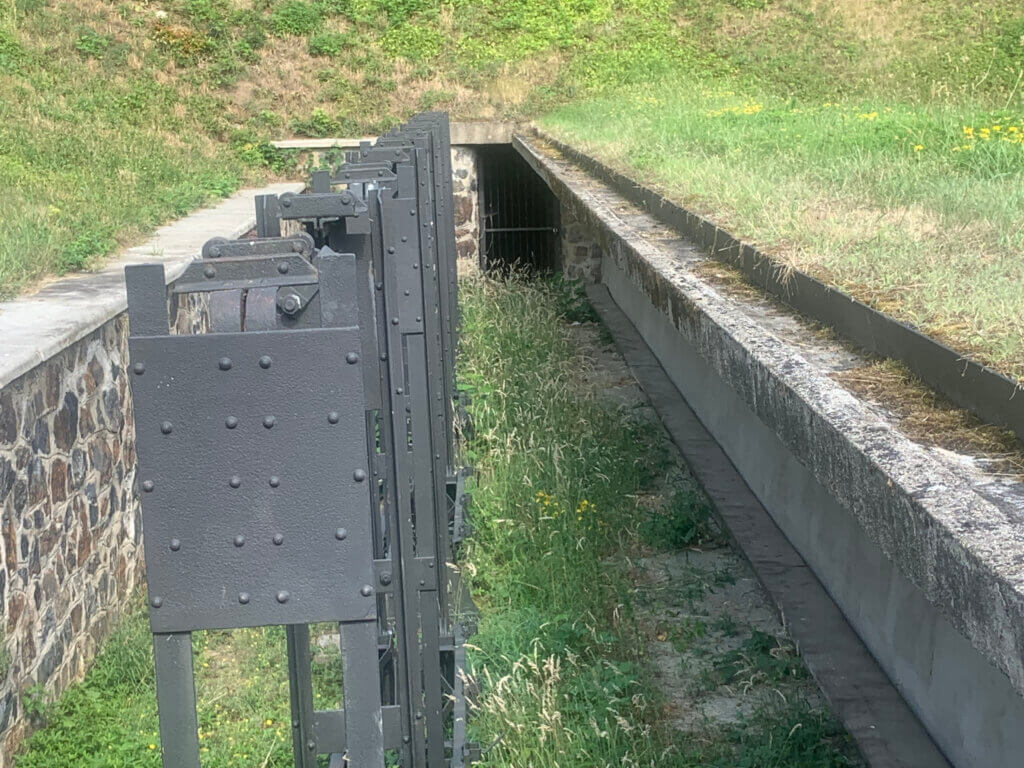
The old shooting targets: a discovery worth looking closer at
At the back of the memorial, there is something visitors can easily overlook: three recessed target pits containing rows of old metal mechanisms.
When I looked more closely at these structures, I wanted to know whether they came from the First Republic or an earlier period. What followed was a search through restoration reports and historical descriptions of the range.
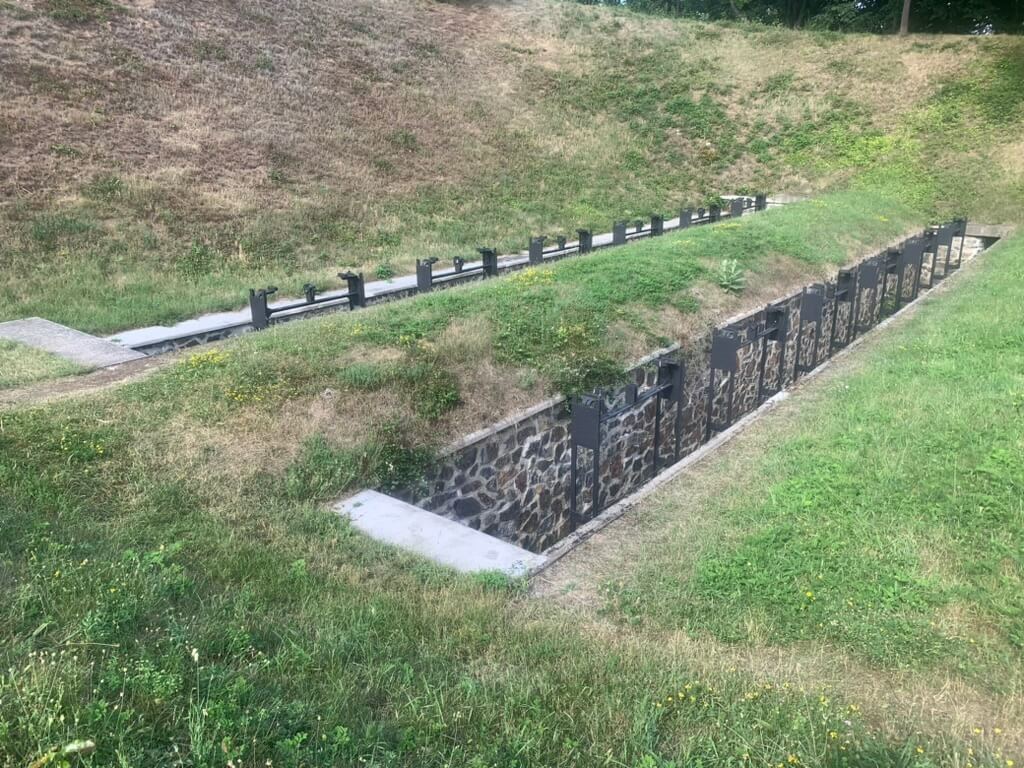
The distinction matters: what survives is principally the equipment used to support and operate shooting targets, rather than the targets themselves.
A Czech Television report quotes a Prague 8 official describing the target pits as dating from before the First World War. This points towards Austro-Hungarian origins for the pits, although the precise age of every surviving metal component remains uncertain. We cannot confidently label all the equipment as original nineteenth-century material.
Over time, vegetation and accumulated soil obscured these structures. During the 2015–2016 restoration, the pits were cleared and the mechanisms repaired. The restored site reopened on 25 April 2016. Their visibility today owes much to that conservation work.
These remains add another layer to a visit. They take us back to the military range that existed before Kobylisy became a place of mourning.

Why did the Nazis use Kobylisy for executions?
The occupation authorities took over an established military compound with shooting facilities, high earth banks and buildings that could be adapted for holding prisoners. The former stable became a waiting place for people condemned to death.
The enclosed terrain and existing facilities help explain its suitability as an execution ground, although we have not identified an original German document explicitly stating why it was selected.
Historical accounts describe restrictions on nearby residents and vehicle engines running to mask the sound of gunfire. Behind those banks, a military training ground became part of the machinery of Nazi terror.
When did executions begin, and how many people died?
Official heritage descriptions date executions at Kobylisy from 30 September 1941, shortly after Reinhard Heydrich arrived in Prague.
The largest wave followed the attack on Heydrich on 27 May 1942. The Military History Institute records 539 victims, including 76 women, during the second martial-law period. Prague 8 dates this wave from 30 May to 3 July 1942.
The overall wartime total remains uncertain. Older official accounts cite more than 755 victims between 1941 and 1945, while a newer memorial-book project refers to 545 victims in 1942–1945. These figures should not be presented as interchangeable or as a settled count. The information board at the memorial also acknowledges that the precise number is unknown.
Alois Eliáš: a prime minister arrested when Heydrich arrived
One of the most remarkable names here is General Alois Eliáš, prime minister of the Protectorate government between 1939 and 1941.
Publicly, he headed a government operating under German occupation. Secretly, he supported the resistance and maintained links with the Czechoslovak leadership in exile.
The Gestapo arrested him on 27 September 1941—the day Heydrich arrived in Prague. Only four days later, on 1 October, he was sentenced to death.
This happened while Heydrich was alive and establishing his rule, almost eight months before the attack. Eliáš had already become a prisoner during the first wave of repression accompanying Heydrich’s arrival.
His execution was postponed, and he remained at Pankrác as a hostage. On 19 June 1942, following a direct order from Heinrich Himmler, he was taken to Kobylisy and shot—one day after the paratroopers’ final battle on Resslova Street.
The Military History Institute identifies Eliáš as the only prime minister of an occupied country executed by the Nazis. His position offered no protection once the occupation authorities decided to kill him.
Josef Mašín and the Three Kings
Josef Mašín was a professional soldier, First World War legionnaire and leading figure in the military resistance.
With Josef Balabán and Václav Morávek, he formed the group remembered as the Three Kings—Tři králové. They gathered intelligence and organised sabotage against the occupation.
On 13 May 1941, Mašín was captured following a shootout with the Gestapo. He covered the escape of Morávek and radio operator František Peltán before being taken prisoner.
More than a year of imprisonment and brutal interrogation followed. On 30 June 1942, a martial-law court sentenced him to death. He was executed at Kobylisy that evening.
Before his death, Mašín wrote farewell messages to his wife and children on toilet paper. They survived and reached his family after the war. In them, a man remembered for his courage becomes a father worrying about the children he will never see grow up, asking them to care for their mother and live honestly.
Knowing about those messages changes how you read his name on the memorial.
Other important people executed at Kobylisy
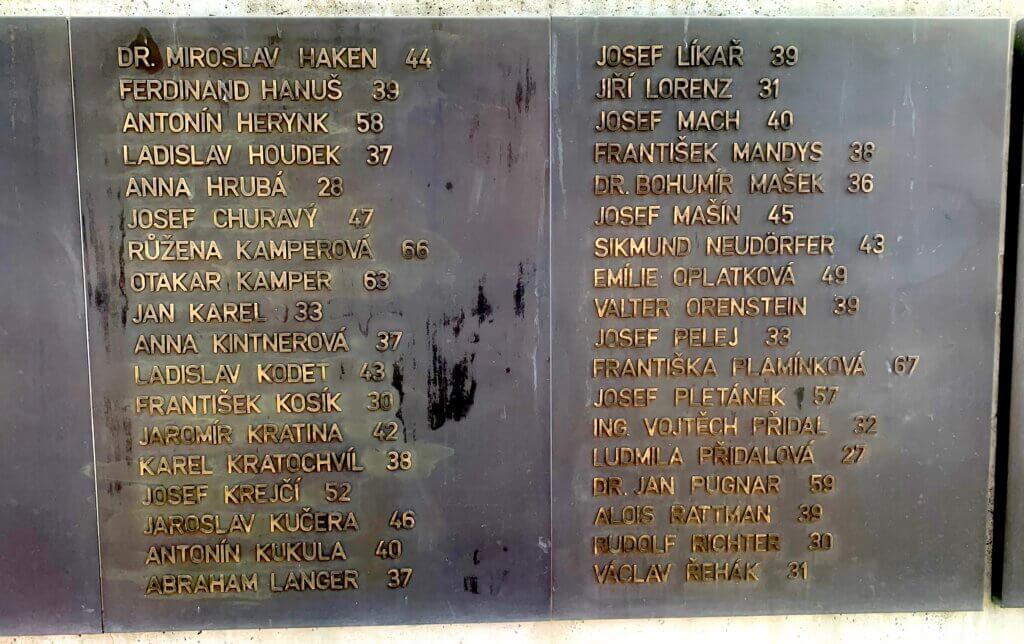
The plaques commemorate people from across Czechoslovak society:
- Vladislav Vančura, doctor, writer and filmmaker, executed on 1 June 1942. His books include Markéta Lazarová and Rozmarné léto.
- Františka Plamínková, senator and campaigner for women’s rights, executed on 30 June 1942.
- Evžen Rošický, Olympic athlete, journalist and resistance member, executed with his father Jaroslav on 25 June 1942.
- Military resistance figures Josef Churavý and Josef Krejčí, also killed here during the repression of 1942.
Alongside these familiar names are hundreds of others whose lives deserve the same attention.
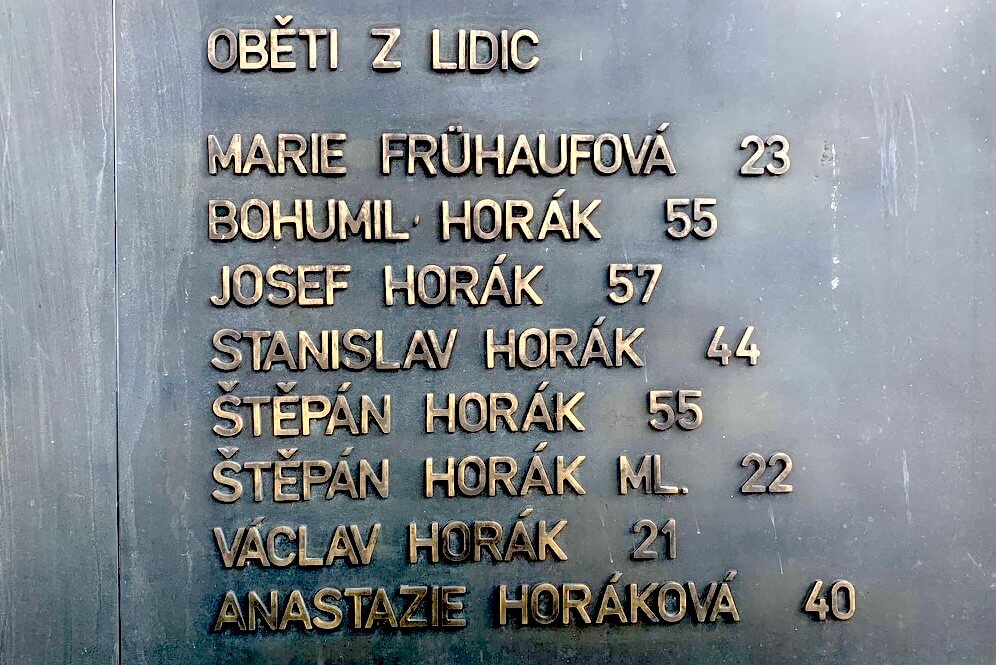
The Lidice victims murdered in Prague
On 10 June 1942, the Nazis shot 173 men and boys in Lidice. But the killing of the village’s residents continued elsewhere.
On the evening of 16 June, another 26 Lidice residents—19 men and seven women—were executed at Kobylisy Shooting Range.
They included 15 members of the Horák and Stříbrný families, relatives of two Lidice men serving abroad with the Royal Air Force. These family members had been arrested on 4 June, before the village was destroyed.
The other victims included seven workers who had been on the night shift, František Pitín, who initially escaped, and Bohumil Pospíšil, brought from hospital with his leg still in a plaster cast. The remaining two were fifteen-year-old boys, Josef Doležal and Josef Nerad.
Lidice had no involvement in the attack on Heydrich. These murders were collective punishment. The victims’ ashes are commemorated at the honorary burial ground at Strašnice Crematorium, another Prague location connected with the tragedy.
The youngest victims: boys aged fifteen and sixteen

The ages beside the names are among the hardest details to take in.
Josef Doležal and Josef Nerad had both turned fifteen that April. Initially taken with the women and children to Kladno, they were removed from the children’s group when the Nazis established their ages. Fifteen was the threshold for including Lidice boys among the men condemned to be shot. They were killed just two months after their birthdays.
Another victim, Jaroslav Belza, was a fifteen-year-old student executed on 1 July 1942. His age and execution date are documented, although the sources consulted do not establish the specific accusation or circumstances of his arrest.
Jaroslav Barcal was executed that same day, only 26 days after his sixteenth birthday. A family-history account preserved in the Volhynian Czechs’ archive describes him as a Sokol member involved in student resistance. According to that account, a fellow student betrayed him, and he was imprisoned and interrogated at Pankrác.
His parents tried to secure his release. Their efforts could not save their only child.
These four names give a painfully human meaning to the numbers recorded at Kobylisy.
Bishop Gorazd and the church helpers who sheltered the paratroopers
The story also connects directly with the Cathedral of Saints Cyril and Methodius on Resslova Street, where seven Czechoslovak paratroopers found shelter.
Jan Sonnevend, chairman of the cathedral’s lay council, helped arrange the refuge through his resistance contacts, with parish priest Václav Čikl’s agreement. Chaplain Vladimír Petřek and Bishop Gorazd, whose civil name was Matěj Pavlík, also became involved.
Several had already helped people persecuted by the occupation. Čikl and Petřek had issued false baptism certificates to Jews and helped shelter resistance leader Přemysl Šámal.
Karel Čurda’s betrayal helped the Gestapo uncover the support network leading to the church. The paratroopers died during the final battle on 18 June 1942.
Afterwards, Gorazd tried to protect his church by accepting responsibility for sheltering them. He was arrested on 25 June.
A Nazi martial-law court at the Petschek Palace sentenced all four men to death on 3 September 1942.
Their executions followed at Kobylisy:
- 4 September: Bishop Gorazd, parish priest Václav Čikl and lay council chairman Jan Sonnevend.
- 5 September: Chaplain Vladimír Petřek.
Visiting the cathedral and Kobylisy connects the place of refuge with the place where these helpers were killed.
Four Czech gendarmes executed in 1943
On 8 July 1943, four gendarmes connected with the resistance were executed here: Josef Bojas, František Famfulík, Jan Jirásek and František Rajmon.
Approximately 150 members of the Protectorate police and gendarmerie were ordered to watch. The execution was intended as a warning against helping the resistance.
Prague Uprising: the final killings in May 1945
On 7 May 1945, during the Prague Uprising, Waffen-SS members shot three local men outside the entrance to the shooting range:
- Josef Kotěšovský, 25
- Stojan Savanžel, 38
- Antonín Toušek, 42
With liberation approaching, three more families lost someone here. Their names belong alongside the better-known victims of 1942.
After the war: communism, paneláky and remembrance
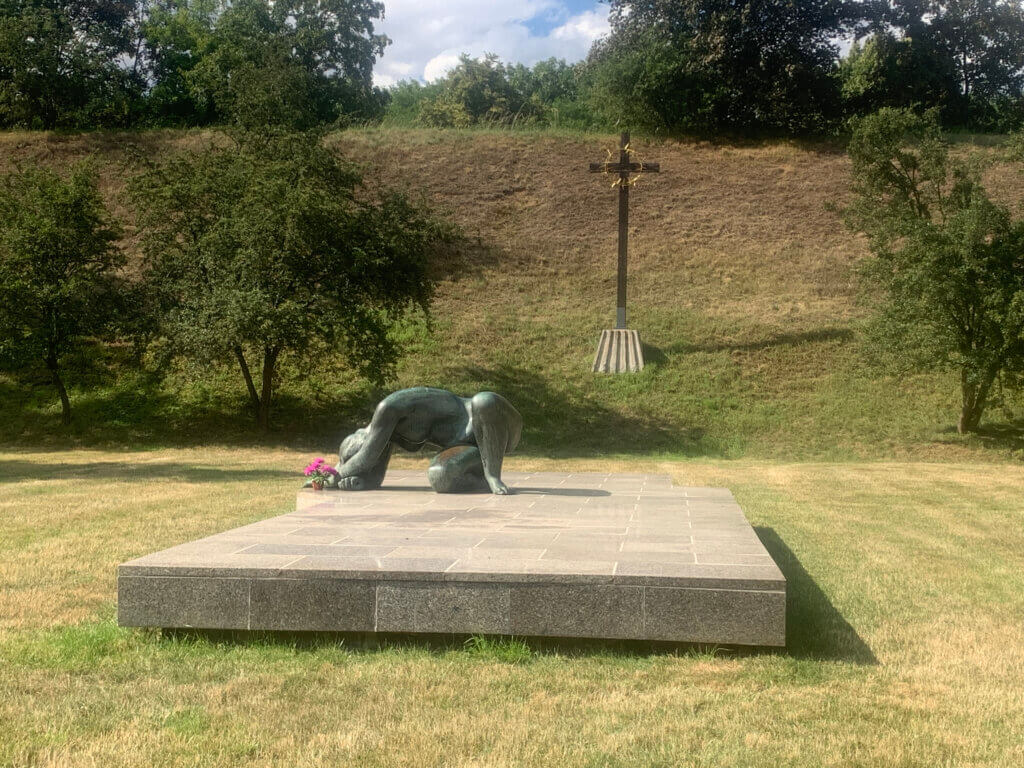
After liberation, a wooden cross with a crown of thorns marked the execution ground. Parts of the wider complex returned to military use.
By the 1950s, the range was becoming unsuitable for modern training. Later users included Svazarm, the communist-era organisation for cooperation with the armed forces, and Armádní film, the military film organisation. Prague 8 records the latter using the site until approximately mid-1968.
The surrounding area changed dramatically as housing estates spread across this part of Prague. Today, the memorial sits beneath the familiar paneláky, the apartment blocks so closely associated with communist-era Czechoslovakia.
People sometimes call them králíkárny—“rabbit hutches.” There is a certain irony in looking up at these once-dismissed blocks and thinking about how much an apartment in Prague can cost today.
The memorial opened in 1975, and Kobylisy Shooting Range became a National Cultural Monument in 1978. A surviving part of the old range was preserved as a place of remembrance within a growing residential neighbourhood.
The cross, mosaic and words of remembrance
The cross marks the execution ground, although it should not be understood as identifying the exact standing position of every victim.
Nearby are Miloš Zet’s sculpture, Nepokořená vlast, approximately translated as The Unbowed Homeland, and Martin Sladký’s stone mosaic, near the former stable where condemned prisoners waited.
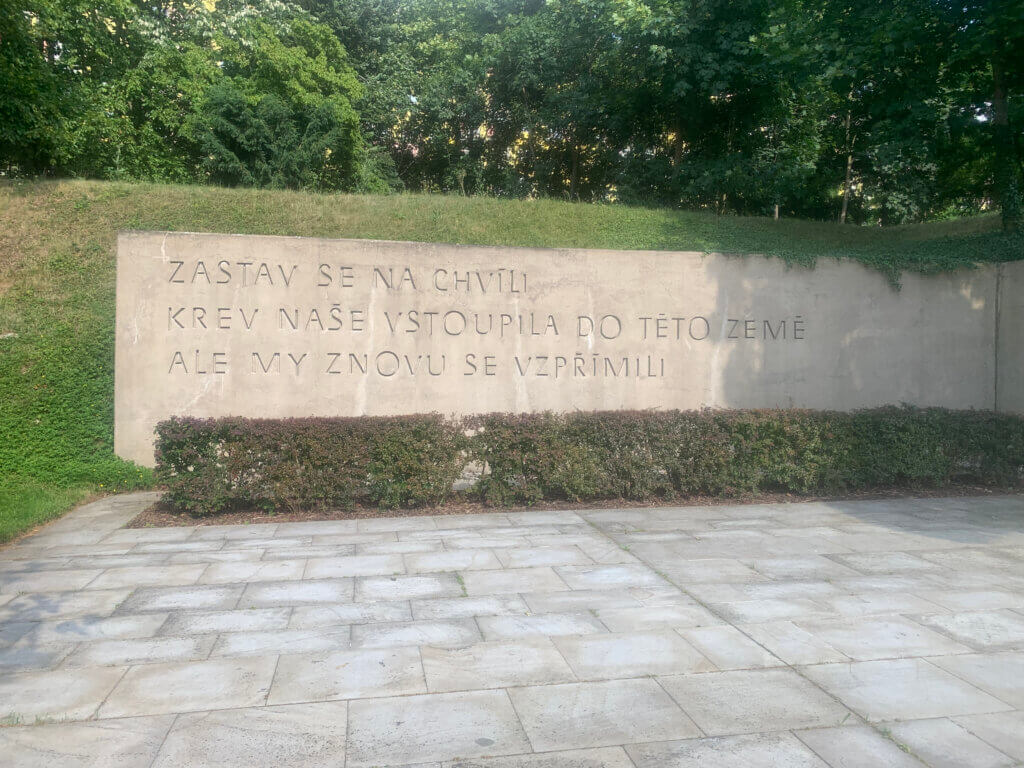
The mosaic and inscription walls belong to the memorial’s development during the 1970s and were later restored.
The wall carries verses by Miroslav Florian:
“Zastav se na chvíli… krev naše vstoupila do této země, ale my znovu se vzpřímili.”
Roughly translated:
“Pause for a moment. Our blood entered this earth, but we rose again.”
Give yourself time here. Read a few names, look at the ages and walk towards the old target pits. Different periods of Prague’s history survive within this small space.
Visit Kobylisy with our Operation Anthropoid tours
Kobylisy Shooting Range is included in both our four-hour and eight-hour private Operation Anthropoid tours.
Our four-hour Prague tour connects the memorial with Ďáblice Cemetery, Heydrich’s Curve, the Jindřiška Nováková memorial, and the cathedral and crypt on Resslova Street. The eight-hour tour also takes us to Lidice, bringing the village and its victims’ stories together.
These are places I believe deserve more attention. Together, they help us understand the people behind Operation Anthropoid and the persecution that reached far beyond the men who carried out the attack.
With private transport and time for questions, we can explore this history beyond Prague’s familiar sights.
Send us an inquiry with your preferred date and group size, and we will help you choose the Operation Anthropoid tour that suits your interests and time in Prague.