
4-hours exploring the people and places behind the mission
Most visitors who know the story of Operation Anthropoid want to see the crypt on Resslova Street. Understandably so. It is where seven Czechoslovak paratroopers fought their final battle, and standing there is an experience that stays with you.
But there is much more to discover across Prague.
In Libeň, a memorial remembers a fourteen-year-old girl who collected a bicycle. At Kobylisy, plaques record the names and ages of people executed by the Nazis. At Ďáblice Cemetery, memorials raise difficult questions about persecution, burial and the families left behind.
Our four-hour Operation Anthropoid tour in Prague brings these places together. Travelling with a professional guide and private transport, we follow the attack on Reinhard Heydrich, the support given to the paratroopers and the consequences for those who helped them.
Understanding Operation Anthropoid
On 27 May 1942, Czechoslovak soldiers Jozef Gabčík and Jan Kubiš attacked Reinhard Heydrich’s car in Prague. Heydrich, the acting Reich Protector of Bohemia and Moravia, died from his injuries on 4 June.
The mission was prepared abroad, but it depended on assistance inside occupied Czechoslovakia. People provided accommodation, food, information and places to hide. Their homes became part of a resistance network in which a single discovery could endanger many families.
Those people are central to our tour. To understand what Gabčík and Kubiš achieved, we also need to understand the help they received.

Ďáblice Cemetery: history beyond the familiar memorials
Ďáblice Cemetery takes us into a part of Prague’s history that many visitors never encounter.
Alongside its distinctive architecture are burial grounds and memorials connected with victims of Nazi persecution and communist terror. Near the northern wall, the visit turns towards collective graves, concealed burials and the difficulties families faced when trying to find out what had happened to their relatives.
The symbolic Children’s Cemetery remembers children born to political prisoners who died in communist-era prisons. Nearby is a memorial to the Anthropoid paratroopers.
An important distinction needs to be made here: the paratroopers’ monument is a cenotaph—a symbolic memorial, rather than a confirmed grave containing their remains.
During our visit, we explain these distinctions carefully. A name on a memorial and an identified burial are not always the same thing.
Ďáblice also broadens the conversation beyond the war. It shows how persecution continued under another regime, and how difficult it could be for families to obtain answers or even a place to mourn.

Kobylisy Shooting Range: the names behind the history
Hidden among Prague 8’s residential buildings, Kobylisy Shooting Range is easy to overlook from the surrounding streets.
Once inside, the earth banks separate the memorial from the neighbourhood around it. The plaques list people murdered by the Nazis, their ages recorded beside their names.
Among those commemorated are Alois Eliáš, Josef Mašín, Vladislav Vančura, Františka Plamínková and residents of Lidice. Some victims were boys aged just fifteen.
There is also a direct connection with the cathedral on Resslova Street. Bishop Gorazd, Václav Čikl, Jan Sonnevend and Vladimír Petřek, who helped provide refuge for the paratroopers, were executed at Kobylisy in September 1942.
Visiting both places allows us to follow their story from the shelter they offered to the place where they were killed.
At the back of the grounds, surviving target pits and mechanisms reveal the range’s earlier military purpose. These remains are worth looking at too: they help explain the unusual landscape preserved between today’s apartment blocks.

Heydrich’s Curve: where the attack took place
At the location commonly called Heydrich’s Curve, we return to the morning of 27 May 1942.
The road layout has changed considerably. Looking at the present-day traffic alone does not make it easy to imagine the scene in 1942. We explain the wartime setting, Heydrich’s journey and the actions of Gabčík and Kubiš.
The Operation Anthropoid Memorial also recognises the Czech patriots who supported the mission. Its inscription makes clear that the soldiers could not have carried out their task without that assistance.
For visitors who have watched Anthropoid or another film about the operation, this is an opportunity to discuss the historical events in their actual surroundings.
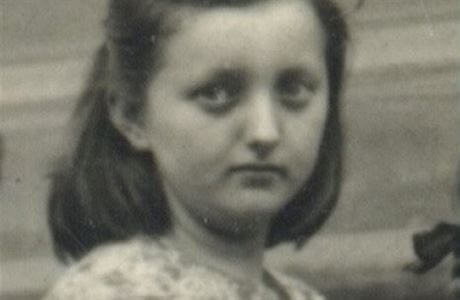
Jindřiška Nováková: the girl with the bicycle
A stop in Libeň remembers Jindřiška Nováková, who was just fourteen.
After the attack, she collected the bicycle Jan Kubiš had abandoned during his escape. The memorial Dívka s kolem—The Girl with the Bicycle recalls that act in the courtyard of the Bohumil Hrabal school.
Unveiled in September 2022, the installation places her story back in the neighbourhood where she lived.
This stop brings home how much the resistance relied on practical help. Someone needed a bed, a meal or clean clothing. A bicycle needed to be removed. These tasks connected ordinary households with an operation that would change their lives.
Jindřiška deserves to be remembered by name, alongside the soldiers she helped.
Betrayal and the search for the paratroopers
The tour also explores how the Gestapo uncovered the support network.
Karel Čurda’s betrayal helped investigators identify the people assisting the paratroopers, eventually leading them to the refuge on Resslova Street.
Understanding that sequence connects the locations we visit. It explains why the story reaches far beyond the two men who attacked Heydrich, into families whose names are less familiar but whose assistance was essential.
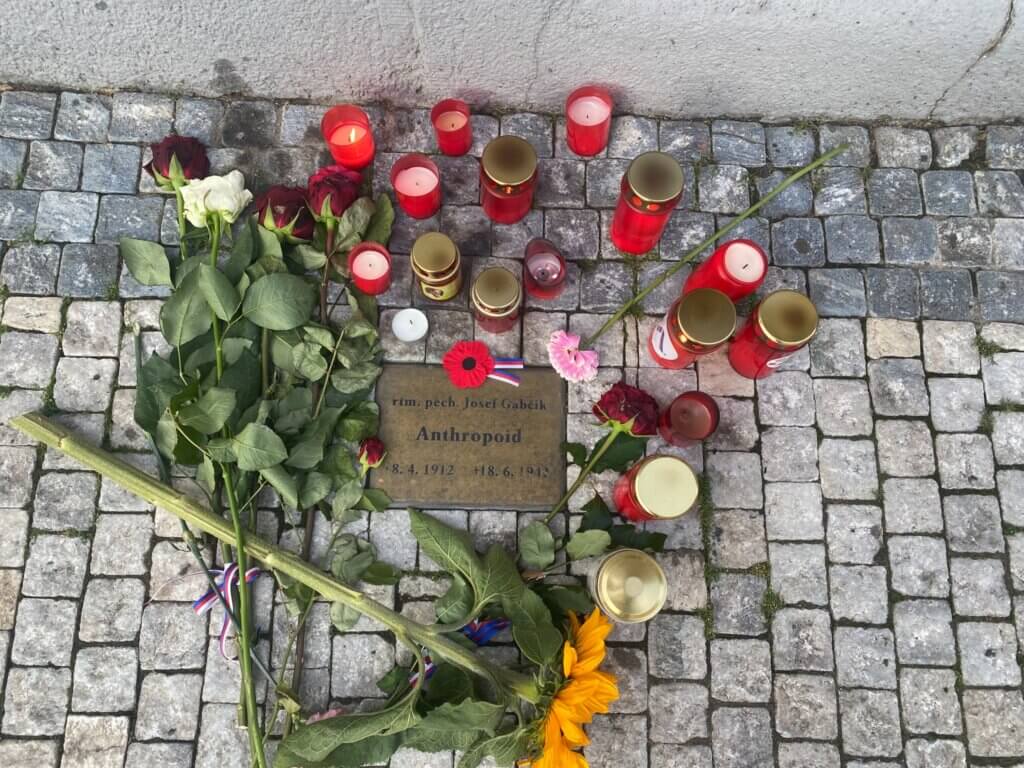
Resslova Street: the final battle and the people who helped
The final part of our tour takes us to the Orthodox Cathedral of Saints Cyril and Methodius on Resslova Street, where seven Czechoslovak paratroopers made their last stand on 18 June 1942.
We begin at the memorial plaques marking the place where the paratroopers’ bodies were laid out for identification after the battle. Here, we remember Jozef Gabčík, Jan Kubiš, Adolf Opálka, Josef Valčík, Josef Bublík, Jan Hrubý and Jaroslav Švarc.
We then walk to the memorial outside the cathedral commemorating resistance helpers and their relatives executed at Mauthausen. After following their stories through Prague, these names carry a particular weight. The memorial remembers the people who provided shelter, food and practical assistance—and the families caught in the Nazi reprisals.
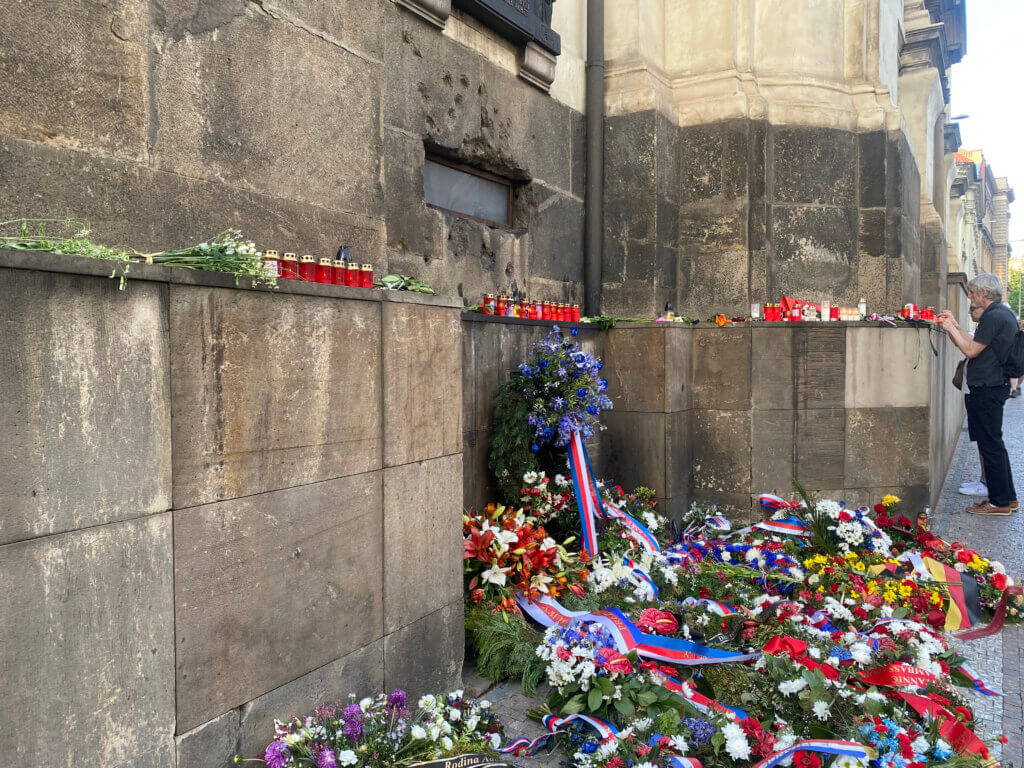
Inside the cathedral and crypt
When no service is taking place, we continue inside the cathedral to explore the church itself and explain its role in the final battle.
Our last historical stop is the National Memorial to the Heroes of the Heydrich Terror, with its exhibition and the crypt where the paratroopers sheltered. Each participant receives an English-language booklet and a map to help them follow the history and take something of the visit home.
There is time to explore the exhibition, remember the seven men and ask any remaining questions.
A final drink at U Parašutistů
We finish at U Parašutistů—the Paratroopers pub, near the cathedral. After an afternoon spent discussing some difficult history, it is a chance to sit down together and continue the conversation.
Each tour participant receives one small beer or a soft drink, included in the tour. The tour ends here at U Parašutistů.