
RAF Air Marshal Karel Janoušek, Czech Military Aviators and the Legacy of Operation Anthropoid
There are places in Prague where history announces itself through grand monuments, museums and memorial plaques. And then there are places where the most extraordinary stories remain almost unnoticed, hidden behind old cemetery walls.
Libeň Cemetery in Prague 8 is one of those places.
At first glance, it is a peaceful historic burial ground, with mature trees, weathered gravestones and quiet pathways. Yet its history connects us to Czechoslovak military aviation, the Royal Air Force during the Second World War, the Prague Uprising of 1945 and the persecution of war veterans under the Communist regime.
Among the people once buried here was Karel Janoušek, the only Czechoslovak to attain the rank of Air Marshal in Britain’s Royal Air Force.
His story is particularly haunting. He helped defend his country against Nazi Germany, only to be imprisoned by the Communist authorities after the war.
But Janoušek is not the cemetery’s only link to Czechoslovak aviation. Another grave belongs to Eduard Šimek, a military pilot whose career was interrupted by the Nazi occupation.
Together, these stories reveal a lesser-known side of Prague’s 20th-century history.
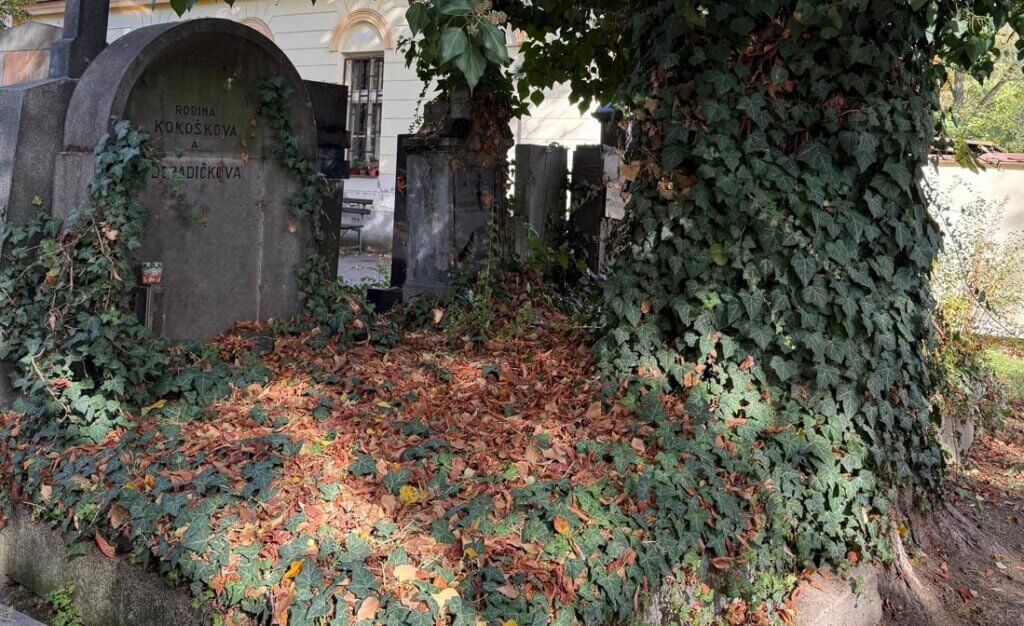
Libeň Cemetery – A Historic Burial Ground in Prague 8
Libeň Cemetery, known in Czech as Libeňský hřbitov, was established in 1881 and consecrated on 5 November 1882.
Before its construction, residents of Libeň buried their dead at the cemetery in nearby Prosek. As the surrounding communities expanded, the old burial ground became overcrowded, and a new cemetery was needed.
The cemetery on Na Korábě gradually expanded over the following decades, becoming the final resting place of generations of local residents.
Today, it is one of Prague’s quieter historic cemeteries, far removed from the crowds visiting the Old Town or Prague Castle.
Its graves tell the stories of ordinary families, artists, military officers and people whose lives were shaped by some of the most dramatic events in modern European history.
Among the notable figures associated with the cemetery are the poet Karel Hlaváček, the architect Jan Krištof and two important personalities from Czechoslovak military aviation.
For visitors interested in dark tourism, forgotten history and Prague beyond the usual tourist attractions, Libeň Cemetery offers something different.
It is not a spectacular monument. Its atmosphere comes from the history preserved within its walls.
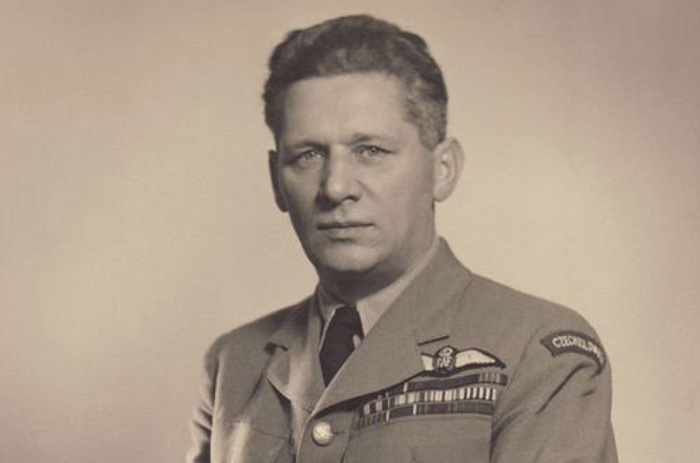
Karel Janoušek – The Czechoslovak RAF Air Marshal
Born on 30 October 1893, Karel Janoušek lived through the collapse of empires, two world wars, the destruction of Czechoslovak independence and the rise of Communist dictatorship.
During the First World War, he served in the Czechoslovak Legions in Russia, joining the struggle for an independent Czechoslovak state.
After the establishment of Czechoslovakia in 1918, he continued his military career and eventually became one of the country’s senior aviation officers.
When Nazi Germany occupied the Czech lands in March 1939, Janoušek refused to accept the destruction of his country’s independence.
He escaped abroad and became involved in the organization of Czechoslovak military forces fighting alongside the Allies.
Following the defeat of France in 1940, he reached Great Britain, where Czechoslovak airmen continued their fight against Nazi Germany.
Czechoslovak Airmen Fighting with the Royal Air Force
During the Second World War, thousands of Czechoslovak servicemen escaped Nazi-occupied Europe to join Allied military forces.
Many entered the Royal Air Force, serving in fighter and bomber squadrons during some of the most dangerous years of the war.
Four Czechoslovak RAF squadrons became particularly important:
- No. 310 Squadron RAF – a fighter squadron formed in July 1940 that participated in the Battle of Britain.
- No. 311 Squadron RAF – a bomber squadron that later served with RAF Coastal Command.
- No. 312 Squadron RAF – a fighter squadron formed in September 1940.
- No. 313 Squadron RAF – a fighter squadron established in May 1941.
These men fought far from home, often knowing that their families remained under Nazi occupation.
Many were killed in combat, aircraft accidents or operations over enemy territory.
Others survived the war but returned to a country where their service with Western Allied forces would eventually make them politically suspect.
Janoušek was not a frontline fighter pilot. His role was primarily one of leadership, organization and representation.
As Inspector General of the Czechoslovak Air Force in Great Britain, he played an important part in coordinating the Czechoslovak aviation presence within the RAF.
In 1945, he attained the rank of Air Marshal, becoming the only Czechoslovak officer to receive that distinction.
It was an extraordinary achievement for a man whose country had been occupied and whose military forces had been forced to continue fighting from abroad.
From RAF War Hero to Communist Prisoner
The end of the Second World War should have brought Karel Janoušek the recognition and peaceful retirement he deserved.
Instead, the years following liberation became another tragic chapter of his life.
After returning to Czechoslovakia, Janoušek witnessed the country’s gradual political transformation.
In February 1948, the Communist Party consolidated its control of the state.
Military officers with strong connections to Britain and other Western Allied countries soon became targets of suspicion.
Former RAF servicemen were particularly vulnerable.
Many were dismissed from the armed forces, stripped of their positions, interrogated, imprisoned or forced to take poorly paid civilian jobs.
The men who had risked their lives fighting Nazi Germany were suddenly treated as enemies by the government of their own country.
The Arrest of Karel Janoušek in 1948
In 1948, Janoušek was arrested following an attempted escape from Czechoslovakia.
He was convicted and sentenced to a lengthy prison term.
During his imprisonment, he endured years of harsh treatment, political persecution and the loss of his military standing.
He was eventually released during the presidential amnesty of 1960, after approximately twelve years behind bars.
Although he received some rehabilitation during the 1960s, the years taken from him could never be returned.
There is something especially disturbing about this chapter of Czechoslovak history.
A man who had helped organize the fight against Nazi Germany was imprisoned by the state he had served.
He had fought for Czechoslovak freedom abroad, only to lose his own freedom at home.
Janoušek’s story is a powerful reminder that the end of one dictatorship does not necessarily guarantee the beginning of freedom.
Karel Janoušek’s Grave at Libeň Cemetery
Karel Janoušek died in Prague on 27 October 1971, just three days before his 78th birthday.
His remains were placed in a family grave at Libeň Cemetery, recorded as grave I-333.
For more than four decades, the cemetery was associated with the resting place of one of the most distinguished Czechoslovak military commanders of the Second World War.
Janoušek never lived to see the Velvet Revolution of 1989 or the collapse of Communist rule.
After democracy was restored, his military reputation received renewed recognition, including posthumous promotion to the rank of army general.
Why Karel Janoušek Is No Longer Buried at Libeň Cemetery
On 12 May 2014, Janoušek’s remains were transferred from Libeň Cemetery to Šárka Cemetery in Prague 6, near the Church of St. Matthew.
The reinterment was attended by family members, veterans’ organizations and representatives of groups dedicated to preserving Czechoslovak military history.
Visitors researching Janoušek’s life should therefore be aware that his remains are no longer at Libeň Cemetery.
Nevertheless, the cemetery remains an important part of his story.
It was his resting place for decades, including the years when the memory of Czechoslovak RAF veterans was still recovering from Communist-era persecution.
His former burial at Libeň also reminds us that historical sites are not always permanent or unchanged.
Graves may be moved, monuments restored and reputations rehabilitated, but the history associated with a place remains.
Eduard Šimek – A Forgotten Czechoslovak Military Aviator
Another fascinating figure associated with Libeň Cemetery is Eduard Šimek (1903–1957), a Czechoslovak military pilot whose career reflects the development of aviation during the First Czechoslovak Republic.
Unlike Karel Janoušek, Šimek was not an RAF commander.
His story belongs primarily to the generation of military pilots who helped develop Czechoslovakia’s air force before the German occupation.
Born on 17 March 1903 in Veselí nad Moravou, Šimek initially trained as a metalworker before volunteering for military aviation.
Between 1924 and 1925, he completed his pilot training at the Military Flying School in Cheb.
He subsequently served with Czechoslovak aviation units in Košice, Olomouc and Prague.
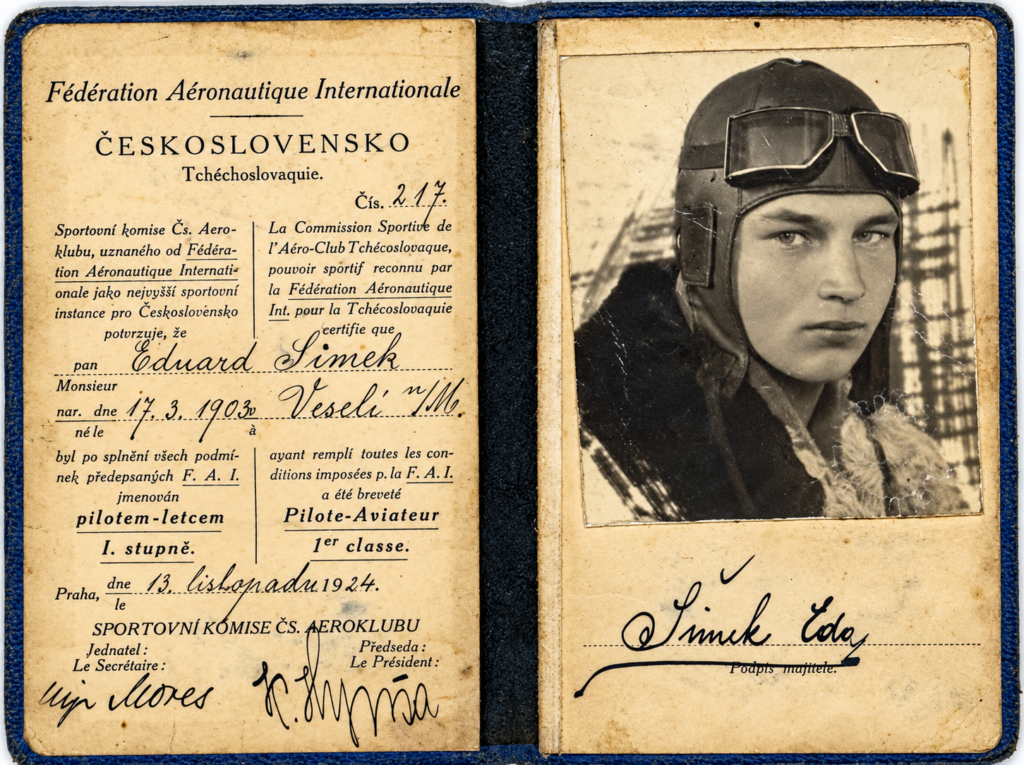
In 1928, he completed fighter-pilot training, gaining experience with several aircraft types used by the Czechoslovak military.
His career later took him into more specialized aviation work.
In 1937, Šimek was transferred to the Military Technical and Aviation Institute, where he initially worked in aerial photography.
From July 1938, he served as a test pilot.
This was an important period for Czechoslovak aviation, as the country faced increasing military and political pressure from Nazi Germany.
Šimek’s surviving flight logbooks provide a fascinating record of the aircraft he flew, his training and the development of military aviation before the war.
A Pilot’s Career Interrupted by Nazi Occupation
The German occupation of March 1939 brought independent Czechoslovak military aviation to an abrupt end.
Aircraft were seized, military institutions dismantled and thousands of servicemen faced an uncertain future.
Some pilots escaped abroad and continued fighting with Allied air forces.
Others remained in the occupied country, where their professional careers were interrupted.
Eduard Šimek belonged to the latter group.
During the occupation, he worked in an administrative position at the District Office in Pelhřimov.
Following liberation in 1945, he did not return to active military flying.
He later worked in civilian administration and industrial employment.
Šimek died on 19 August 1957.
His grave at Libeň Cemetery bears the inscription “Polní pilot – letec”, meaning military field pilot or aviator.
Although there is no verified evidence establishing that Šimek served in the wartime RAF, his life remains an important part of Czechoslovakia’s aviation heritage.
His story represents a generation of skilled pilots whose careers were disrupted by the destruction of their country’s independence.

Libeň Cemetery and the Prague Uprising of May 1945
Libeň Cemetery also preserves memories of the final days of the Second World War.
On 5 May 1945, the Prague Uprising began as Czech resistance fighters and civilians rose against the German occupation.
Barricades appeared across the city, and fierce fighting continued over the following days.
For Prague’s residents, liberation came at a terrible cost.
Many people who had survived almost six years of Nazi occupation lost their lives during the final struggle.
Among the military graves recorded at Libeň Cemetery is that of Captain František Novák, an artillery officer killed during the Prague Uprising on 5 May 1945.
The cemetery also contains a memorial dedicated to those who fell defending their homeland during the fighting of 5–9 May 1945.
These memorials preserve the memory of people who fought and died in the closing days of the war.
Not every hero of the Prague Uprising became a famous historical figure.
Some are remembered primarily through a name, a date and a gravestone.
Yet their sacrifices formed part of the final struggle to end Nazi occupation in Prague.

Libeň and Operation Anthropoid – A District That Changed History
Libeň is also one of the most important districts in the history of Operation Anthropoid.
On 27 May 1942, Czechoslovak paratroopers Jozef Gabčík and Jan Kubiš attacked Reinhard Heydrich, the acting Reich Protector of Bohemia and Moravia.
The operation had been planned by the Czechoslovak government-in-exile in cooperation with British special operations authorities.
Heydrich was one of the most powerful men in Nazi Germany and a central figure in the regime’s machinery of terror.
The attack took place at a sharp bend in the road in Libeň, where Heydrich’s vehicle slowed.
Gabčík attempted to fire his Sten submachine gun, but the weapon failed.
Kubiš then threw an explosive device at the vehicle, seriously wounding Heydrich.
Heydrich died from his injuries on 4 June 1942.
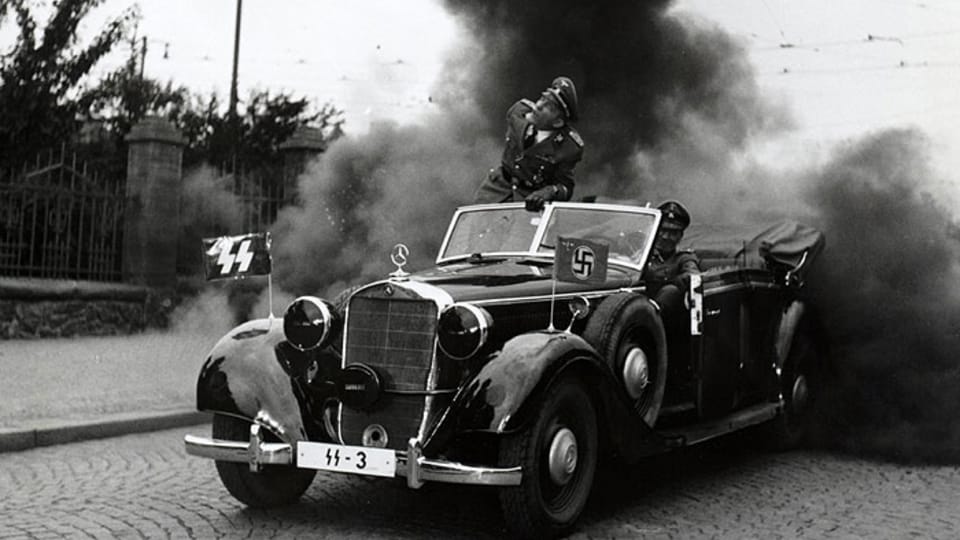
The attack became one of the most significant acts of resistance against a senior Nazi official during the Second World War.
The Nazi Reprisals Following Operation Anthropoid
The consequences were devastating.
The Nazi authorities launched a campaign of terror across the Protectorate of Bohemia and Moravia.
Thousands of people were arrested, interrogated or imprisoned, and many were executed.
The village of Lidice was destroyed on 10 June 1942, followed by the destruction of Ležáky later that month.
Families who had supported the resistance faced imprisonment, deportation and execution.
On 18 June 1942, seven Czechoslovak paratroopers made their final stand at the Orthodox Church of Saints Cyril and Methodius in Prague’s New Town.
After hours of fighting against overwhelming German forces, all seven were dead.
Today, the church and its crypt form the National Memorial to the Heroes of the Heydrich Terror.
Although Libeň Cemetery itself was not the location of the assassination or the paratroopers’ final battle, it belongs to the same Prague district where one of the most consequential resistance operations of the war took place.
For visitors exploring Operation Anthropoid, the cemetery adds another layer to the history of Prague 8.
Visiting Libeň Cemetery Today
Libeň Cemetery is located at Na Korábě 322, Prague 8, within easy reach of the Bulovka public transport stop.
Unlike Prague’s most famous attractions, it remains a relatively quiet place.
There are no crowds gathering around its historic graves, and many visitors pass through the surrounding neighborhood without realizing the significance of the cemetery.
That is part of what makes it worth exploring.
A visit provides an opportunity to reflect on the lives of people whose stories connect to the First Czechoslovak Republic, the Second World War and the decades of Communist rule.
The cemetery is managed by Prague’s municipal cemetery administration, through the Ďáblice Cemetery Administration.
Seasonal opening hours:
- January–February: 8:00 AM–5:00 PM
- March–April: 8:00 AM–6:00 PM
- May–September: 8:00 AM–7:00 PM
- October: 8:00 AM–6:00 PM
- November–December: 8:00 AM–5:00 PM
Opening hours may change, so visitors should check the cemetery administration’s current information before traveling.
As with any burial ground, visitors should respect the graves, ceremonies and families who come here to remember their loved ones.
Halloween, Samhain, All Saints’ Day and All Souls’ Day – A Time for Remembrance
Autumn is a particularly atmospheric time to explore Prague’s historic cemeteries.
As October draws to a close, the trees turn golden, leaves gather along the pathways and the first candles begin to appear on family graves.
The season brings together several traditions associated with death, remembrance and the changing of the year.
Halloween, celebrated on 31 October, has become widely associated with costumes, ghosts and supernatural folklore.
Samhain, an ancient Gaelic seasonal festival, marks the transition into the darker half of the year and is associated in later traditions with the boundary between the living and the dead.
All Saints’ Day, observed on 1 November, honors the saints in Christian tradition.
All Souls’ Day, observed on 2 November, is dedicated to remembering the faithful departed.
In the Czech Republic, visiting cemeteries and lighting candles for deceased relatives is an important tradition during this period.
At Libeň Cemetery, the atmosphere becomes especially moving.
But for those interested in history, the cemetery offers something beyond the seasonal beauty.
It reminds us that behind every gravestone is a human story.
Some belong to people who lived quiet lives. Others belong to those who witnessed war, occupation, resistance and political persecution.
And sometimes, the most haunting stories are not supernatural at all.
They are entirely human.
Why Libeň Cemetery Deserves to Be Remembered
Prague is filled with famous monuments, but some of its most important historical stories survive in places that receive relatively little attention.
Libeň Cemetery is one of them.
Its association with Karel Janoušek recalls the extraordinary courage of Czechoslovak airmen who fought alongside the RAF and the injustice many experienced after returning home.
The grave of Eduard Šimek preserves the memory of the skilled military aviators who helped build Czechoslovakia’s prewar air force.
The memorials connected to the Prague Uprising remind us of those who died during the final days of Nazi occupation.
And the surrounding district of Libeň connects these stories to Operation Anthropoid, one of the most significant resistance operations of the Second World War.
For me, places like Libeň Cemetery are an important part of exploring Prague’s history.
They remind us that history is not confined to museums or famous monuments.
Sometimes it is waiting behind an old cemetery gate, along a quiet pathway or beneath a name carved into stone.
The men who fought for freedom deserve to be remembered. So do those whose stories were almost forgotten.
And that is precisely why places like Libeň Cemetery matter.
Interested in Cemeteries and Haunted Places in Prague?
If you enjoy exploring historic cemeteries, forgotten burial grounds and places connected to Prague’s darker past, there is another fascinating location worth discovering.
Ďáblice Cemetery in Prague 8 has an especially haunting history, with mass graves associated with victims of both Nazi and Communist persecution.
Its story reveals another disturbing chapter of the 20th century, where political violence, unmarked graves and decades of silence left lasting scars.
Read our article: Ďáblice Cemetery – WWII, Operation Anthropoid and Prague’s Dark History
Discover another side of Prague, where history is often darker, more complicated and far more fascinating than the usual tourist attractions.
Historical research for this article draws on records from Prague’s municipal cemetery administration, Prague 8, the Czech Ministry of Defence, the National Museum’s published research into Eduard Šimek, and military memorial records. Karel Janoušek is the confirmed RAF figure formerly buried at Libeň Cemetery; Eduard Šimek’s documented career was in Czechoslovak military aviation rather than the wartime RAF.